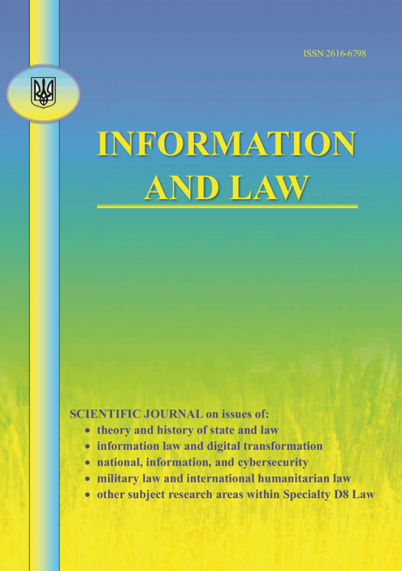



Scientific professional journal "Information and law"

Registered by Ministry of Justice of Ukraine (Certificate of state registration of printed communication media: KV Series № 20117-9917РR dated 05.07.13).

Pursuant to Order of the Ministry of Education and Science of Ukraine dated 02.07.20 № 886 (Annex 4), the journal is included in the List of scientific professional publications of Ukraine, category “B”, branch of science - legal, specialty - 081. The journal can publish materials related to thesis works aimed on the receipt of scientific degrees of Doctor of philosophy – Ph.D. (candidate of sciences) and Doctor of Sciences in the area of Juridical Science.

The printed journal INFORMATION AND LAW is included in the international database of journal, in accordance with relevant ISSN number, is placed on the information platform “Scientific Periodicals of Ukraine”, through which integration with the regional DOI Register, CrossRef System, ORCID International Register is carried out.

The founders of journal are:

State Scientific Institution “Institute of Informatics, Security and Law of National Academy of Law Sciences of Ukraine”

Vernadsky National Library of Ukraine of National Academy of Sciences of Ukraine

Open Іnternational University of Human Development “Ukraine”.
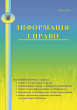
 

INFORMATION ABOUT THE SCIENTIFIC PUBLICATION

1. The purpose and objectives of the scientific publication

The scientific journal «Information and Law» is published by the State Scientific Institution «Institute of Information, Security and Law of the National Academy of Legal Sciences of Ukraine» with the aim of promoting the development of complex theoretical and applied research in the direction D-08 «Law», highlighting and dissemination of scientific achievements on current problems of the state and law, legal support in the information sphere, in the field of digital transformation and of national security and defense field in the context of solving strategic tasks related to security and defense, post-war recovery and development, European and Euro-Atlantic integration of Ukraine.

The main objectives of the scientific journal:

  • development of scientific thought in the fields of: theory and history of the state and law, information law, military law, national and international security law, international humanitarian law and other fields of science;
  • dissemination of research results on current problems of the formation and development of the information society and the knowledge society, ensuring information and cyber security, countering information aggression, protecting the rights and security of people and society in the information sphere;
  • coverage of the latest achievements in digital transformation, dissemination of information (digital) technologies, immersive technologies and artificial intelligence, formation and development of legislation in this area;
  • publication of research results on current legal problems of ensuring the sovereignty and territorial integrity of Ukraine, development of security and defense forces, countering armed aggression, social and legal protection of service members and their families;
  • assistance in the detection and investigation of international crimes (war crimes, crimes of aggression and genocide, crimes against humanity) and other violations of international humanitarian law  committed against Ukraine by the aggressor country.
 

2. Requirements for registration and publication procedures for articles.

The editorial board of the journal draws the attention of the authors of the articles submitted for review and selection for publication to the need to comply with the rules established by the order of the Ministry of Education and Science of Ukraine «On Amendments to the Procedure for Forming the List of Scientific and Professional Publications of Ukraine» dated January 28, 2026 № 129/45523.
In connection with the above, it is proposed to:
  1. Submit the article in Ukrainian in the form of a file:

– in the Word text editor, font – Times New Roman, file extension - *.doc, font size– 13;
–  page parameters –А4 format, text (table) layout book, page margins (top, bottom, left and right) – 20 mm;
–  line spacing – 1 interval;
– material volume for one articleup to 15 pages

The article should provide for the following mandatory structural elements:

 ·  UDC;
·  first and last name (in Ukrainian and English), academic degree, author's academic title and place of work, as well as ORCID identifier;
·  title of the article (in Ukrainian and English);
· Summary and Keywords (in Ukrainian and English);
·  addressing the problem by solving the issue scientifically:
- problem statement (general characteristics);
- the results of the analysis of scientific publications (research), where the problem solving was initiated, the selection of its parts remaining unsolved, to which the article is devoted;
- providing arguments that confirm the relevance and novelty of the work;
aim formation (task statement) of the article;
presentation of the main material – description of the solution to the task and justification of the scientific value and practical significance of the results defined in the article;
· conclusions based on the results of addressing the problem and solving the task, which determine the scientific novelty of the work. They can be accompanied by proposals, assessments, hypotheses described in the article, as well as determination of prospects for further research;
·  references. A bibliographic description of the list of references can be drawn up by the author optionally, taking into account the National Standard of Ukraine DSTU 8302:2015 “Information and documentation. Bibliographic reference. General provisions and rules for drawing up”, or the style of the APA (American Psychological Association) or the style of OSCOLA (Standard of the University of Oxford for citing legal documents) listed by p. 11. of the Order of the Ministry of Education and Culture of Ukraine dated January 12, 17 № 40 as recommended styles for drawing the list of scientific publications;
·   author’s address (e-mail), phone number.
  1. Submit a written Feedback for an article signed by a person with a scientific degree (in case the author does not have a scientific degree).

Feedback must be clearly structured and justified as follows:
·  relevance of the topic;
·  novelty and validity of the obtained scientific result;
·  scientific (practical) value of results;
·  conclusion on the possibility of publication in a scientific journal.
  1. the article manuscript and Feedback must be carefully proofread.

  4.  Conflict of interest. Authors need to disclose all potential sources of conflict of interest. A conflict of interest is any interest or relationship that can be perceived as affecting the objectivity of the author. They must be disclosed if they are directly related or connected explicitly to the work that the authors describe in their manuscript. The existence of a conflict of interest does not prevent publication. If the authors do not have a conflict of interest, they must declare it when submitting the article and include the corresponding statement in the "Conflict of Interest" section. The corresponding author is responsible for familiarizing themselves with this policy together with all authors and collectively disclosing all relevant commercial and other connections when submitting the article. Detection of improper disclosure of conflicts of interest during the submission of an article or during the review process may lead to rejection of the manuscript.
If there is no conflict of interest, then «None» should be indicated.
 

3. Procedure for handling complaints on violations of academic integrity and publication ethics

Complaints Policy

The journal's editorial board ensures that complaints related to the editorial process are dealt with in a transparent, objective and timely manner, and that the principles of academic integrity and publication ethics are respected.

General Provisions

A complaint is any appeal regarding possible violations in the process of submission, review, editorial review or publication of scientific materials.
The editors guarantee impartial consideration of all complaints regardless of the status of the applicant.

Subject matter of complaints

Complaints may concern, in particular:
  • violation of the principles of academic integrity (plagiarism, falsification, data fabrication);
  • conflict of interest;
  • violation of the review procedure or reviewer bias;
  • illegal editorial decisions;
  • copyright infringement;
  • ethical violations in scientific publications;
  • delays or improper communication by the editorial board.

Complaint submission

The complaint is submitted to the editorial board of the journal in written (electronic) form and must contain:
  • name and contact details of the applicant;
  • clear description of the essence of the complaint;
  • where possible – evidence or links to relevant materials.
Anonymous complaints can be considered only if there are sufficient grounds and evidence.

Review procedure

1) Complaint registration – the editors confirm receipt of the complaint.
  1. Preliminary analysis – determination of its validity and subject matter.
  2. Substantive consideration:
    1. involvement of relevant members of the editorial board;
    2. requesting explanations from interested parties (authors, reviewers, etc);
    3. if necessary – involvement of independent experts.
  3. Decision-making by the Editorial Board.
  4. Informing the applicant of the outcome of the proceedings.

Possible Decisions

Based on the results of the complaint consideration, the editors can:
  • dismiss the complaint as unfounded;
  • initiate additional review;
  • make corrections to the publication;
  • publish a rebuttal or clarification;
  • withdraw (retract) the article;
  • apply other measures in accordance with editorial policy.

Principles of complaint handling

The editors are guided by the following principles:
  • objectivity and impartiality;
  • information confidentiality;
  • respecting the rights of all parties;
  • timeliness of consideration;
  • compliance with international standards of publication ethics.

Appealing decisions

In case of disagreement with the decision of the editorial board, the applicant may file a repeated complaint with additional arguments or evidence, which is considered in accordance with the established procedure.
 

4. Policy for the use of AI and AI-enabled technologies, permissible and unacceptable areas of AI application in the publication preparing process, requirements for disclosure of information about the use of AI by authors

The journal's editorial board recognizes that artificial intelligence (AI) tools can be used as aids in scientific activities. At the same time, the application of such tools must comply with the principles of academic integrity, transparency and responsibility of authors for the content of scientific publications.
Artificial intelligence cannot be the author of a scientific work, as it is not legally responsible for the content, reliability and scientific novelty of the research results.

Use of AI  by authors

Authors can only use artificial intelligence tools as an aid (for example, for language editing, translation, text structuring, or information analysis), provided the following requirements are met:
• authors are fully responsible for the content, reliability and scientific correctness of materials prepared using AI;
• the use of AI must not lead to copyright infringement, academic integrity violation or the creation of inaccurate information;
• authors must indicate the fact of using AI tools when they are used during manuscript preparation (in a separate note);
• AI cannot be listed as a co-author of the publication.

Use of AI by reviewers

When reviewing manuscripts, reviewers must ensure the confidentiality of materials submitted to the editorial office. In this regard:
  • reviewers are not allowed to upload manuscripts or parts thereof to artificial intelligence systems or other external services without the permission of the editorial board;
  • reviewers are personally responsible for preparing the review and cannot entrust its writing to AI tools;
  • the use of AI is allowed only as an auxiliary tool for general analysis or language editing of the review text without disclosing confidential information.

Use of AI by the Editorial Board Members

Members of the editorial board can use artificial intelligence tools to technically and organizationally support the editorial process (for example, to check language, structure texts, find sources), provided that following principles are complied with:
  • responsible and transparent use of artificial intelligence technologies in scientific and editorial activities;
  • compliance with standards of academic integrity, confidentiality and scientific ethics;
  • the decision to accept, rework or reject manuscripts must be made exclusively by people.
 

5. Procedure for withdrawing published articles

The editors of the journal «Information and Law» adhere to the principles of academic integrity and ensure transparency of scientific communication in accordance with the COPE guidelines. In case of detection of violations of scientific ethics or significant errors in already published materials, the editors may make a decision on retraction (revocation / withdrawal) of the article.

Grounds for withdrawing the article

The article may be withdrawn if the following circumstances are established:
  • detection of plagiarism, self-plagiarism or other violations of academic integrity;
  • falsification or fabrication of research results;
  • significant errors in data or conclusions that make research results unreliable;
  • re-publication of the same work in other publications without proper notification to the editors;
  • violation of copyright or other rights of third parties;
  • establishing the fact of improper authorship;
  • violation of ethical research norms;
  • covert or undeclared use of artificial intelligence systems to create text, images or other data in a manuscript is considered a serious violation and may be grounds for revocation. Authors are required to inform transparently about the application of such tools. Concealment of such facts may be considered as grounds for revocation. The editors reserve the right to check manuscripts for the use of generative artificial intelligence systems. For this, automated detection tools, expert evaluation of reviewers and additional requests to authors can be used.

Initiation of the withdrawal procedure

The grounds for initiating consideration of the withdrawal may be:
  • appeal of the author or co-authors of the article;
  • appeals from readers, reviewers or other researchers;
  • journal editorial review results;
  • information received from scientific institutions or other publishers.

Consideration procedure

1) The editors conduct a preliminary analysis of the received information.
2) The author(s) of the article are informed of the circumstances identified and given the opportunity to provide an explanation.
3) If necessary, the editors may engage independent experts or reviewers for additional review.
4) After reviewing the materials, the editorial board makes a decision on:
  • no grounds for revocation (withdrawal);
  • making corrections (corrigendum or erratum);
  • withdrawal of the article.

Publication of withdrawal

In case of a decision on withdrawal:
  • an official notice of withdrawal of the article is published on the journal's website;
  • the revocation notice contains the title of the article, author details, issue number and reasons for the revocation;
  • the electronic version of the article is stored in the journal archive, but is marked as «Retracted / Withdrawn»;
  • information about the revokation is brought to the attention of the relevant scientometric and information databases.

Principles of article withdrawal

The revocation procedure is carried out in compliance with the following principles:
  • transparency and validity of editorial decisions;
  • objectivity and impartiality of proceedings;
  • respecting authors' rights;
  • ensuring the reliability of the scientific archive of the journal.
 

6. Information about payment for processing and publication of articles or its absence

General provisions

This policy defines the conditions for financing costs related to editorial processing, review, preparation for printing and publication of scientific articles in the Journal, as well as the conditions for free publication and provision of open free access to all articles and issues of the Journal.

Free publication

Scientific articles of the Institute's employees (in accordance with the Collective Agreement between the Directorate and the Institute's Labor Staff) are published in the Journal free of charge. Students of the third level of higher education who study at the Institute full-time can also publish scientific articles in the Journal free of charge.

Open («diamond») access to articles and issues of the Journal

All articles and issues of the scientific periodical «Information and Law» are provided with open («diamond») access (free for all authors and users) on the official website of the Journal.  

Fees for processing and publishing articles

1) For authors of scientific articles (except those specified in clause 2), a fixed fee for processing and publishing the article (Article Processing Charge – APC) is established in the amount 750 (seven hundred and fifty) hryvnias.
2) The said fee shall cover the costs relating to:
  • organization of double «blind» review;
  • literary and technical editing;
  • layout and preparation of the electronic version;
  • posting the full text of the article on the official website of the Journal;
  • preparation of a printed copy.
3) The author makes payment only after:
  • receiving positive reviews;
  • official notification from the editorial board on acceptance of the article for publication.
4) Submission of an article to the editorial office, its consideration and review are free of charge. No fee is charged if publication is refused.

Transparency Principles

The editors guarantee that the decision to accept or reject an article is made exclusively on the basis of its scientific quality, relevance and compliance with the Journal's profile and does not depend on the fact or possibility of payment.
The policy on payment for services is open, applies to all materials submitted for publication and covered on the official website.

Details for payment of publication services: State scientific institution «Institute of Information, Security and Law of the National Academy of Legal Sciences of Ukraine». A/c UA288201720313201002201011870 in the State Treasury Service of Ukraine, MFO: 820172, EDRPOU/ USREOU: 25959933 (with remark – for scientific journal).

Editorial address: 04053, Ukraine, Kyiv, Nestorivskyi lane, 4.

Please send a copy of the receipt to the e-mail addressdorohykh@gmail.com.


7. Review procedure, description of the type of review, criteria for selecting reviewers, terms, forms of documentation and decision-making

Peer review (expert evaluation) of manuscripts is carried out to ensure a high scientific and theoretical level of the journal «Information and Law». The purpose of review is to facilitate the careful selection of author's manuscripts for publication, to provide an objective assessment of the quality of the submitted material, as well as to determine the level of its compliance with scientific, literary and ethical standards. All reviewers must be objective and comply with the provisions of the Publication Ethics section.
  1. Journal «Information and Law» adheres to double-blind (anonymous) review:
  • reviewers do not know the personal data of the authors;
  • authors do not know the personal data of the reviewer.
  1. Scientific articles submitted to the editorial office are checked for plagiarism and compliance with the requirements placed in the Publication Terms section. Scientific articles designed in accordance with the General Requirements section, which have passed initial control in the editorial office and copyright verification, are allowed to the review stage.
  2. The initial examination of the scientific article is carried out by the editor-in-chief or his deputy. The materials sent must correspond to the topic of the journal. In case of compliance with the requirements for the publication of the journal, the article is handed over to the technical editor, who provides the article with a registration code and deletes information about the author or authors from it.
  3. An anonymous article is sent by e-mail to:
    • the member of the editorial board responsible for the scientific direction of the article;
    • two external independent experts (reviewers).
Ukrainian and foreign doctors of science specializing in the same scientific field as the authors of the article are involved in external review. A letter with a request for review is sent to such a scientist on behalf of the editors. An anonymous article and a typical review form are attached to the letter. Reviewers may not be associated with the same institution as the author and may not have a conflict of interest.
  1. In the process of reviewing scientific articles, reviewers highlight the following issues:
    • correspondence of the content of the article to the topic stated in the title;
    • relevance and novelty of the scientific problem discussed in the article;
    • substantiation of the practical significance of the conducted research;
    • value for a wide range of readers.
  2. After peer review of the article, reviewers may:
    • recommend the article for publication;
    • recommend the article for publication after minor corrections;
    • recommend the article for publication after significant changes;
    • not to recommend the article for publication.
If the reviewers' recommendation regarding the article is to reject or to revise, then they must provide a written reasoned explanation of the reasons for such a decision. Reviews signed by reviewers with a regular or electronic signature are stored in the editorial office for 3 years from the date of publication of the issue of the journal in which the reviewed article is published.
  1. The decision of the editorial board is sent to the authors. Articles to be revised are sent together with the review text without identifying the reviewers. The corrected version of the article is sent for re-review, during which reviewers may ask for additional corrections. Rework does not guarantee acceptance of the article, and if reviewers find the changes unsatisfactory, then the article will be rejected.
  2. The editor-in-chief is responsible for the final decision on whether to accept or reject articles. He does not participate in the decision-making process regarding articles authored by himself, his family members or colleagues, as well as materials related to products or services in which he has a personal interest. All such materials undergo standard journal procedures with independent review, which does not involve the participation of the editor or his research group.
 

8. Publication ethics and editorial policy of the publication, which corresponds to the recommendations of COPE or other recognized international organizations in the field of public ethics

Publication ethics and editorial policy of the publication

The editorial policy of the journal «Information and Law» is based on the principles of academic integrity, scientific objectivity, transparency and responsibility of all participants in the editorial process. The journal adheres to internationally recognized standards of publication ethics, including the recommendations of the Committee on Publication Ethics, and also takes into account the best practices of scientific publishing.

General Principles

The editors provide:
  • objectivity, impartiality and transparency of editorial decisions;
  • compliance with the principles of academic integrity;
  • confidentiality of the editorial process;
  • prevention of discrimination on any grounds;
  • prevention of conflicts of interest;
  • responsible use of modern technologies, including artificial intelligence tools.

Decision-making regarding publications

The decision to accept, finalize or reject a manuscript in the journal «Information and Law» is made by the editorial board based on the results of an independent review, scientific significance, novelty, validity of the obtained results, as well as compliance with the topic and requirements of the journal. The final decision is made by the responsible editor or editorial board, taking into account the conclusions of the reviewers, but is not a mechanical reproduction of them.
The editors ensure impartiality and objectivity of the decision-making process, respecting the principles of confidentiality, non-discrimination and avoidance of conflicts of interest. All manuscripts are considered exclusively according to their scientific content, without taking into account the personal characteristics of the authors, their institutional affiliation or other non-scientific factors.
If necessary, the editors may require the authors to rework the manuscript taking into account the comments of the reviewers or conduct an additional review. The editorial decision is final, however, the authors have the right to file a reasoned appeal in accordance with the established complaints procedure. The decision-making process is carried out in compliance with the recommendations of the Committee on Publication Ethics and is aimed at ensuring the high quality of scientific publications.

Confidentiality.

The editors ensure strict confidentiality at all stages of manuscript review. Information about the submitted materials, their content, authors, reviewers and the progress of the review is not subject to disclosure to third parties, except for cases provided for by editorial policy or legislation. All participants in the editorial process are required to use the information received solely within the scope of the performance of their functions.

Settlement of conflict of interest.

The editors pay special attention to identifying and resolving conflicts of interest that may affect the objectivity of editorial decisions. All participants in the process (authors, reviewers and members of the editorial board) are required to report on the existence of a real or potential conflict of interest in a timely manner.
If a conflict of interest is established, the editors take appropriate measures, in particular, remove the interested person from participating in the review of the manuscript, appoint another reviewer or transfer the decision to an independent member of the editorial board. This ensures the impartiality and independence of the editorial process.
Failure to disclose a conflict of interest or its detection after a decision is made may become the basis for revising an editorial decision, making corrections or withdrawing (retracting) an article.

Responsibilities of the editors

Editorial office of the magazine:
  • selects and publishes materials exclusively on the basis of their scientific value, relevance and correspondence to the topic of the journal;
  • ensures independent and impartial review of manuscripts;
  • makes a decision on publication based on the results of review and editorial evaluation;
  • responds to violations of publication ethics, including plagiarism, fabrication and falsification of data;
  • if necessary, applies procedures for correction or retraction of published materials.

Responsibilities of authors

Authors are required to:
  • submit original scientific works that have not been previously published and are not under consideration in other publications;
  • ensure the reliability of the provided data and research results;
  • properly design links to used sources;
  • comply with authorship requirements and avoid unfair co-authorship practices;
  • disclose information about sources of funding and possible conflicts of interest.

Responsibilities of reviewers

Reviewers:
  • carry out an objective, impartial and reasoned evaluation of manuscripts;
  • observe the confidentiality of information obtained during review;
  • inform the editors about possible ethical violations or conflicts of interest;
  • do not use manuscript materials in their own research before their publication.

Responsibilities of the Editorial Board members

Editorial Board members:
  • promote compliance with publication ethics standards;
  • ensure the quality of scientific content of the journal;
  • avoid conflicts of interest when making editorial decisions;
  • participate in the formation of the journal's scientific policy.

Adherence to ethical standards

Journal does not allow:
  • plagiarism and other forms of academic dishonesty;
  • fabrication or falsification of research results;
  • copyright infringement;
  • review manipulations;
  • discriminatory or unethical practices in scientific activity.
In case of violations, the editorial office acts in accordance with established procedures, in particular the policy of retraction, consideration of complaints and settlement of conflicts of interest.

Compliance with international standards

The editorial policy of the journal meets international standards of scientific publication ethics and is aimed at the integration of Ukrainian legal science into the world scientific space.

Authorship statement 

The editorial board of the journal «Information and Law» assumes that all authors agree with the content of the article, have given express consent to its publication and have received consent from those responsible at the institute/organization where the work was performed before the article was submitted for consideration.
All authors whose names are indicated in the application declare that they:
- have made an essential contribution to the development of the concept or structure of the work; to the collection, analysis or interpretation of data;
- prepared research material or critically reviewed it for important intellectual content;
- approved version for publication;
- agree to be responsible for all aspects of the work, ensuring that matters relating to the accuracy or integrity of any part of the work are properly investigated and resolved.
The editorial board of the journal «Information and Law» encourages cooperation with colleagues in the places where research is conducted and expects their inclusion as co-authors if they meet all the authorship criteria described above. Contributors who do not meet all authorship criteria must be listed in section «Acknowledgments».

Declaration of submission

The work described has not previously been published, is not considered for publication elsewhere, its publication is approved by all authors and responsible authorities where the research was carried out. If accepted, it will not be published elsewhere in the same form, in English or any other language.
 

9. Type of licensing for the use of copyright objects

Creative Common License. It is an open access article distributed under the CC BY-NC-ND 4.0 license that allows use, distribution, and reproduction on any medium, provided the author and non-commercial use are indicated.


10. Composition of the editorial board

THE SCIENTIFIC COUNCIL OF THE JOURNAL

Pylypchuk Volodymyr, Doctor of Juridical Science, Professor, Аcademician NАLS of Ukraine – Chairman of Editorial Board.

Bebyk Valerii, Doctor of Political Sciences, Professor – Vice-chairman of Editorial Board.

Dubrovina LyubovDoctor of Historical Sciences, Professor, Corresponding Member National  Academy of Sciences of Ukraine – Vice-chairman of Editorial Board.

Furashev Volodymyr, Сandidate of Engineering Sciences, Associate Professor, Senior researcher fellow.

Kopan Oleksii, Doctor of Juridical Science, Professor.

Kuibida Vasyl, Doctor of Administration Science, Professor.

Marushchak Anatolii, Doctor of Juridical Science, Professor

Nor Vasyl, Doctor of Juridical Science, Professor, Аcademician NАLS of Ukraine.

Onishchenko Oleksii, Doctor of Philosophical Science, Professor, Аcademician NAN of Ukraine.

Petryshin Oleksandr, Doctor of Juridical Science, Professor, Аcademician NАLS of Ukraine.

Pokutnyi Serhii, Doctor of Physics and Mathematics Sciences, Professor.

Savinova Nataliia, Doctor of Juridical Science, Senior researcher fellow.

Shemshuchenko Yuriі, Doctor of Juridical Science, Professor, Аcademician NAN of Ukraine.

Skulysh Ievhen, Doctor of Juridical Science, Professor.

Talanchuk Petro, Doctor of Engineering Sciences, Professor.

Tykhyi Volodymyr, Doctor of Juridical Science, Professor, Аcademician NАLS of Ukraine.


EDITORIAL BOARD

Bukhanevych Oleksandr, Doctor of Juridical Science, Professor, Corresponding Member National Academy of Sciences of Ukraine – Editor in Chief.

Bryzhko Valerii, Doctor of Рhilosophy of Juridical Science, Senior researcher fellow  Vice-Editor.

Dovgan Oleksandr, Doctor of Juridical Science, Professor – Vice-Editor.

Aristova Iryna, Doctor of Juridical Science, Professor.

Baranov Oleksandr, Doctor of Juridical Science, Senior researcher fellow.

Bednaruk Waldemar, Doctor habilitowany (Catholic University of Lublin, Poland).

Bieliakov Konstiantyn, Doctor of Juridical Science, Professor.

Chistokletov Leontiy, Doctor of Juridical Science, Professor.

Dz’oban Oleksandr, Doctor of Philosophical Science, Professor.

Doronin Ivan, Doctor of Juridical Science, Associate Professor.

Zolotar Оlga, Doctor of Juridical Science, Senior researcher fellow.

Korzh Ihor, Doctor of Juridical Science, Senior researcher fellow.

Lande Dmytro, Doctor of Engineering Sciences, Professor.

Nastiuk Vasyl, Doctor of Juridical Science, Professor, Corresponding Member NАLS of Ukraine.

Tkachuk Taras, Doctor of Juridical Science, Associate Professor.

Shevchuk Oleksandr, Doctor of Juridical Science, Associate Professor.

Schaffler Tomasz, Doctor of Рhilosophy of Juridical Science (University of Wroclaw, Poland).

Vronska Tamara, Doctor of Historical Science, Senior researcher fellow.


11. Contact information of the editorial board


12. Archive with original information of the publication 

(http://il.ippi.org.ua/index)


13. Adherence to principles and recommendations of COPE, WAME, DORA etc.

The editors of the journal «Information and Law» are guided in their activities by internationally recognized principles of publication ethics and best practices of scientific publishing. In particular, the journal's editorial policy complies with the recommendations of the Committee on Publication Ethics, as well as the principles of the San Francisco Declaration on Research Assessment regarding the evaluation of scientific results.
The journal enforces ethical standards at all stages of the editorial process (from the submission of a manuscript to its publication), including transparency of editorial procedures, objectivity of review, prevention of conflicts of interest, prevention of plagiarism and other forms of academic dishonesty. Special attention is paid to ensuring the quality of scientific content and the reliability of research results.
The editors also support the principles of responsible evaluation of scientific results, in particular the rejection of the exclusive use of quantitative scientometric indicators as a criterion for the quality of research, which corresponds to the approaches of the San Francisco Declaration on Research Assessment. The evaluation of manuscripts is carried out taking into account their scientific novelty, methodological validity, practical significance and contribution to the development of the relevant field of knowledge.
The editors of the journal are constantly improving their policies and procedures taking into account the updated recommendations of international organizations and strive to ensure the integration of the journal into the world scientific space based on high ethical standards.
 

14. Open access archiving and long-term storage policy, information on repositories, technical means and accessibility guarantees

The editors of the journal ensure long-term storage and open access to published materials in order to guarantee their availability, preserve scientific work and support the principles of open science.

Archiving and repositories

Electronic versions of articles are archived:
  • on the magazine's official website;
  • in the digital repository of the founding institution – State Scientific Institution «Institute of Information, Security and Law of the National Academy of Legal Sciences of Ukraine».

Technical means of storage

To ensure the reliability of information storage, the editors use:
  • backup of electronic materials;
  • use of stable storage formats (PDF, XML, etc.);
  • use of digital object identifiers (DOIs).
  • placement of materials in the Open Journal Systems system.
  • placement of materials on servers with the appropriate level of technical protection.

Accessibility guarantees

The editorial board provides open, free and permanent access to the full texts of the journal's publications without time limits.
In case of termination of the journal or change of the technical platform, the editors take measures to transfer the archive to the relevant institutions or repositories, which guarantee the further preservation and availability of materials.

Principles of archiving policy

The journal archiving policy is based on the following principles:
  • long-term preservation of scientific content;
  • openness and availability of research results;
  • reliability and security of storage;
  • compliance with international standards of scientific publishing.

Open Access Policy

The policy of open access to all articles and issues of the Journal is based on the principles formulated in the Budapest Open Access Initiative (Budapest Declaration on Open Access) and is aimed at ensuring free unlimited access without charge to the results of scientific research.
1) General Provisions
The journal provides open access to all published materials without setting a fee for viewing, downloading or using the full texts of the articles.
Access to electronic versions of articles is provided immediately after their official publication.
Users have the right to read, download, copy, distribute, print, search and refer to the full texts of articles, provided that the authorship and source of the publication are properly indicated.
2) Electronic open access
The full texts of all articles are publicly available on the Journal's official website.
Access to materials does not require registration or payment of any fees.
Electronic materials are stored for the purpose of long-term archiving and ensuring access stability.
3) Self-archiving and reuse
Authors retain the right to post published versions of their articles in institutional or thematic repositories with reference to an official publication in the Journal.
Reuse of materials is allowed in compliance with academic integrity and correct bibliographic citation.
4) Printed copies and scientific communication
The journal is sent out taking into account the requirements of the Decree of the Cabinet of Ministers of Ukraine «On the procedure for delivering mandatory copies of documents» dated 10.05.2002 № 608.
To ensure wide scientific access, printed copies of the Journal are sent to the National Scientific Library of Ukraine named after V.I. Vernadskyi of the National Academy of Sciences of Ukraine and other specialized library institutions, scientific institutions and institutions of higher education. In the context of ensuring law-making activities, copies of the Journal are also sent to the Apparatus of the Verkhovna Rada of Ukraine.
5) The purpose of open access policy
The implementation of this Policy is aimed at:
  • increasing the availability of scientific research results;
  • promoting the development of national and international scientific communication;
  • increasing the level of citation and influence of scientific publications;
  • integration of Ukrainian science into the European and world scientific space.
The Open Access Policy is an integral part of the Journal's editorial policy and applies to all materials accepted for publication.
 

15. Databases and indices that include publication (with mandatory reference to the publication profile in each of the databases indicated)

1) National Scientific Library of Ukraine named after V.I. Vernadskyi of the National Academy of Sciences of Ukraine

http://www.irbis-nbuv.gov.ua/cgi-bin/irbis_nbuv/cgiirbis_64.exe?Z21ID=&I...

2) Google Scholar

https://scholar.google.com.ua/scholar?as_q=&as_epq=&as_oq=&as_eq=&as_occt=any&as_sauthors=&as_publication=Інформація+і+право&as_ylo=&as_yhi=&hl=uk&as_sdt=0%2C5

3) IAS "Ukrainian Scientific Periodicals". Register of scientific publications of Ukraine

https://nfv.ukrintei.ua/view/5b1925e27847426a2d0ab3e9


TABLE OF CONTENTS

№ 2(45)/2023

№ 1(44)/2023

№ 4(43)/2022

№ 3(42)/2022

№ 2(41)/2022

№ 1(40)/2022

№ 4(39)/2021

№ 3(38)/2021

№ 2(37)/2021

№ 1(36)/2021

№ 4(35)/2020

№ 3(34)/2020

№ 2(33)/2020

№ 1(32)/2020

№ 4(31)/2019

№ 3(30)/2019

№ 2(29)/2019

№ 1(28)/2019

№ 4(27)/2018

№ 3(26)/2018

№ 2(25)/2018


Видання НДІІП